
Bhutan
Discover Bhutan’s beauty, culture, and serene landscapes firsthand today.
Introduction
A tiny landlocked kingdom in the Himalayas, Bhutan, is a Buddhist state enclosed in a cocoon of time with a population of just over 700,000 people and a territory of 38,394 square kilometers. Known to the world outside as the “Land of the Thunder Dragon”, the “Gross National Happiness (GNH) Country” and indeed as the “Last Shangri-La”, Bhutan has a remarkably rich history, evident now in its unique culture and practices that have been pass down through the generations and kept in all its grandeur. From its wooded ridges to its cultivated lowlands, Bhutan’s landscape bears witness to the philosophical faith shared by its entire people. Monasteries, chortens, and prayer flags are along every road and alike in the obscurest corners of the mountains. It is a country of modest but extraordinary proportions and a sanctuary of Buddhist peace, distant from the noise and tumult of the great cities. Though extremely young as a nation-state, we believe it has inhabited as early as the country as 2000 B. C; clear from revelations of vestiges of ancient stone implements, earthenware, and stone structures from its various regions.
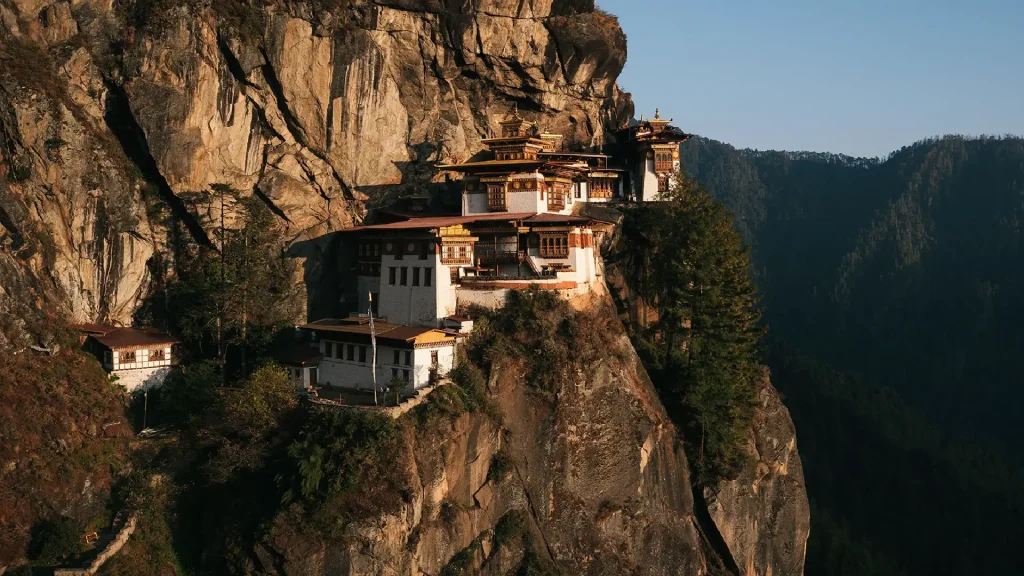
From a nature-worshipping race, the nations converted to Buddhism after Buddhist Saints and Lamas (learned Buddhist teachers) from Tibet from as early as the 8th century. Divided among various warring rulers, a Tibetan Lama Zhabdrung Ngawang Namgyal, who had fled Tibet following a controversy over the throne of the traditional Drukpa Kagyud seat and inheritance of Ralung unified as a nation-state in the late 17th century of the country. Most of the majestic dzongs (fortresses) seen in Bhutan today were established by him. These formidable and located fortresses acted as the line of defense against external invasions while also serving as centers for administration.
Soon after the Zhabdrung’s demise and after much domestic conflict, followed by a war with the British in India, the nations elected Gongsar Ugyen Wangchuck as their first hereditary Monarch on 17th December 1907. Thus commenced the rule of the Wangchuck dynasty, which has continued to its present Monarch Jigme Khesar Namgyel Wangchuck, who is the fifth in the royal bloodline. This history is a testament to the case that even a small nation-state of less than a million can be successful in every sense of the word and can strengthen from theocracy to absolute monarchy to democracy with no form of turmoil or anarchy.
The only country today with Mahayana Buddhism as its state religion, Bhutan, had been as mythical as it was unknown to the outside world, save for Tibet and the bordering states of India with whom it had early trade affiliations. By opening diplomatic ties with India, Bhutan ended its centuries-old isolation from the outside world. This wise and calculated move by the Third Monarch, Druk Gyalpo Jigme Dorji Wangchuck, was a stepping-stone in the country’s advent into modernization. After constructing the first motor road which connected the country’s capital Thimphu to India in the early 1960s, a new chapter in Bhutan’s history began; They admitted the country to the United Nations Organization (UNO) in 1971, after attending as an observer for three years. Through initiatives at the national level, coupled with foreign help, the country has seen major reforms in all sectors making life much more comfortable for the people.
Today Bhutan is a steadily developing nation. Even today, Bhutan jealously guards its lifestyle and ancient traditions, opening its doors with caution and wisdom. And despite the fast-paced metamorphism into a modern state, all that has not overwhelmed the Bhutanese the marvels of modern science offer; they still hold dear the age-old tradition and customs passed on by their ancestors, practiced at every moment of their lives.
Facts of Bhutan
Land area of Bhutan: 38,394 square kilometers
Forest Coverage in Bhutan: 72.5 %
Altitude: between 240metres and 7541metres above sea level
Bhutanese Inhabitants: 634,982
Languages In Bhutan: official language “Dzongkha”, English widely spoken
Religion in Bhutan: Vajrayana stream of Mahayana Buddhism (Also known as Tantric Buddhism)
Bhutanese Currency: Ngultrum (equal to Indian Rupee)
Bhutan Local time: Six hours ahead of GMT and half an hour ahead of Indian Standard Time
Capital of Bhutan: Thimphu
Bhutan’s National Tree: Cypress
Bhutan’s National Bird: Raven
Bhutan’s National Flower: Blue Poppy
Bhutan’s National Sport: Archery
National Animal of Bhutan: Takin
Arts & Crafts
In Bhutan, the traditional arts are known as Zorig chusum (zo = the ability to make; rig = science or craft; chusum = thirteen). These practices have been gradually developed through the centuries, often passed down through families with long-standing relations to a particular craft. These traditional crafts represent hundreds of years of knowledge and ability that has been passed down through generations.
The great 15th century terton, Pema Lingpa is traditionally credited with introducing the arts into Bhutan. In 1680, Ngawang Namgyal, the Zhabdrung Rinpoche, ordered the establishment of the school for instruction in the thirteen traditional arts. Although the skills existed much earlier, it is believed that the Zorig chusum was first formally categorized during the rule of Gyalse Tenzin Rabgye (1680-1694), the 4th Druk Desi (secular ruler).
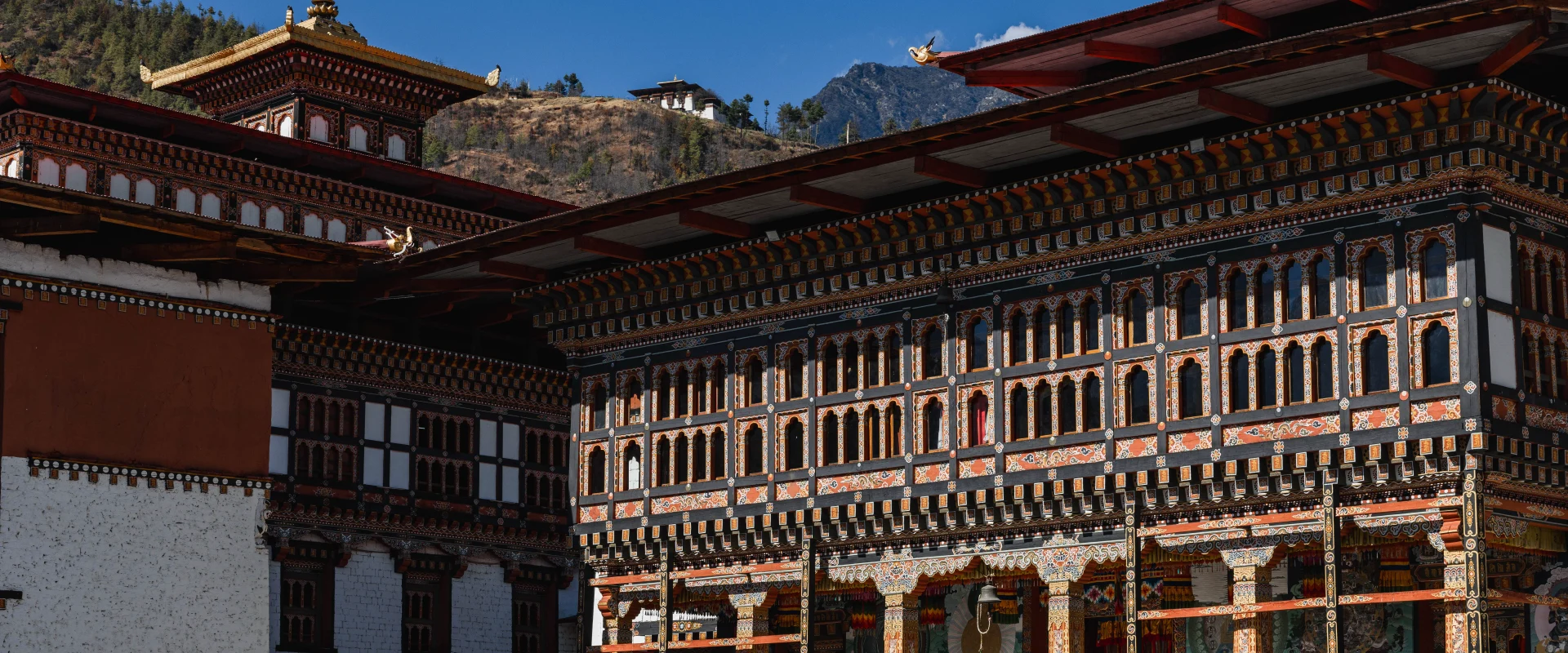
Types of Arts & Crafts in Bhutan
Dezo: (Paper Making) Handmade paper made mainly from the Daphne plant and gum from a creeper root.
Dozo:(Stonework) Stone arts used in the construction of stone pools and the outer walls of dzongs, gompas, stupas and some other buildings.
Garzo:(Blacksmithing) The manufacture of iron goods, such as farm tools, knives, swords, and utensils.
Jinzo: (Clay arts) The making of religious statues and ritual objects, pottery and the construction of buildings using mortar, plaster, and rammed earth.
Lhazo:(Painting) From the images on Thangka, walls paintings, and statues to the decorations on furniture and window-frames.
Lugzo:(Bronze casting) Production of bronze roof-crests, statues, bells, and ritual instruments, in addition to jewelry and household items using sand casting and lost-wax casting. Larger statues are made by reposes.
Parzo: (Wood, slate, and stone carving) In wood, slate or stone, for making such items as printing blocks for religious texts, masks, furniture, altars, and the slate images adorning many shrines and altars.
Shagzo:(Woodturning) making a variety of bowls, plates, cups, and other containers.
Shingzo: (Woodworking) Employed in the construction of dzongs and gompas
Thagzo: (Weaving) The production of some of the most intricately woven fabrics produced in Asia.
Trozo: (Silver- and gold-smiting) Working in gold, silver, and copper to make jewelry, ritual objects, and utilitarian household items.
Tshazo: (Cane and bamboo work) The production of such varied items as bows and arrows, baskets, drinks containers, utensils, musical instruments, fences, and mats.
Tshemzo: (Needlework) Working with needle and thread to make clothes, boots, or the most intricate of applique Thangka.
Culture & Tradition
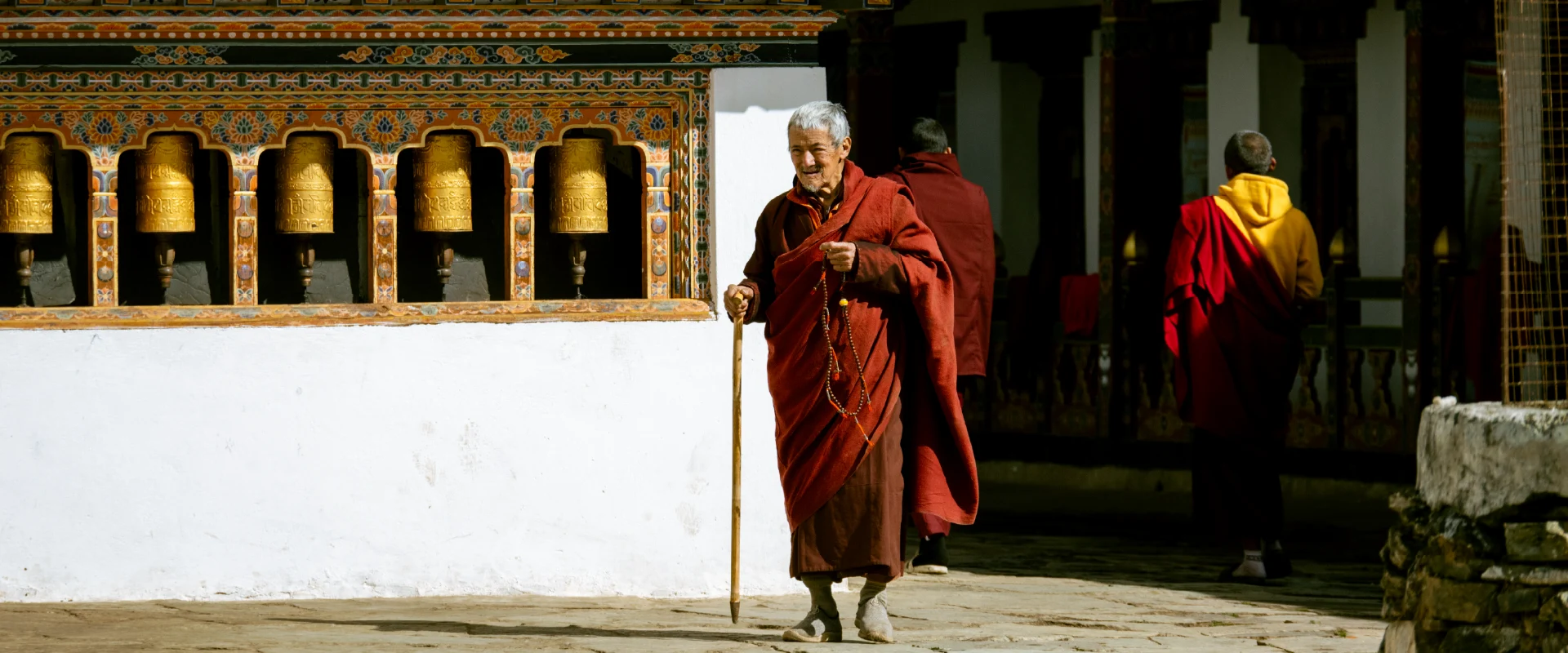
While Bhutan is one of the smallest countries in the world, its cultural diversity and richness are profound.
As such, strong emphasis is laid on the promotion and preservation of its unique culture. By protecting and nurturing Bhutan’s living culture, it is believed that it will help guard the sovereignty of the nation.
Food Habit
Rice, and increasingly maize, are the staple foods of the country. The diet in the hills also includes chickens, yaks meat, beef and Sheep mutton. Soups of meat, rice, and dried vegetables spiced with chilies and cheese are a favorite meal during the cold seasons. Dairy foods, particularly butter and cheese from yaks and cows are popular, and indeed almost all milk is turned to butter and cheese. Popular beverages include butter tea, sweet tea, locally brewed rice wine and beer.
Traditional Sports in Bhutan
Bhutan’s national sport is archery, and competitions are held regularly in most villages. It differs from Olympic standards not only in technical details such as the placement of the targets and atmosphere. There are two targets placed over 100 meters apart and teams shoot from one end of the field to the other. Each member of the team shoots two arrows per round. Traditional Bhutanese archery is a social event and competitions are organized between villages, towns, and amateur teams. There are usually plenty of food and drink complete with singing and dancing. Wives and supporters of the participating teams cheer. Attempts to distract an opponent include standing around the target and making fun of the shooter’s ability.
Darts (Khuru) is an equally popular outdoor team sport, in which heavy wooden darts pointed with a 10 cm nail are thrown at a paperback-sized target ten to twenty meters away. Football is an increasingly popular sport. Golf is fast becoming a popular sport.
Bhutanese Music
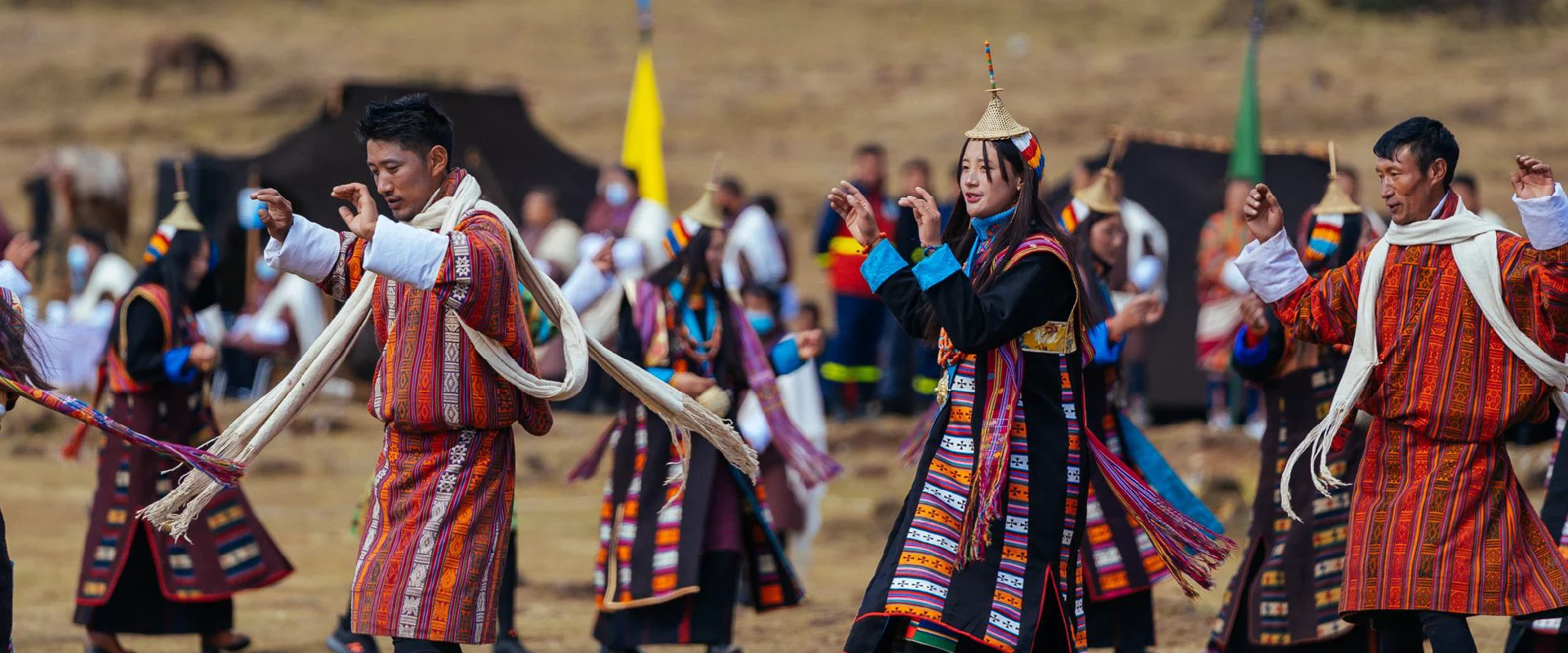
Rigsar (Modern) is the new emergent style of popular music, played on a mix of traditional instruments and electronic keyboards, and dates back to the early 1990s; it shows the influence of Indian popular music, a hybrid form of traditional and Western popular influences. Traditional genres include the Zhungdra and Boedra.
Holidays In Bhutan
Bhutan has numerous public holidays, most of which center around traditional seasonal, secular and religious festivals. They include the winter solstice, Lunar New Year, King’s Birthday, Coronation Anniversary, National Day, the Official Start of Monsoon Season, and various Buddhist and Hindu celebrations. Even the secular holidays have religious overtones, including religious dances and prayers for blessing the day.
Festival Celebration In Bhutan
Masked dances and dance dramas are common traditional features at festivals, usually accompanied by traditional music. Energetic dancers, wearing colorful wooden or composition facemasks and stylized costumes, depict heroes, demons, death heads, animals, gods, and caricatures of common people. The dancers enjoy royal patronage, and preserve ancient folk and religious customs and perpetuate the ancient lore and art of mask making.
Gross National Happiness & Bhutan
Gross National Happiness (GNH) as the development ideology of the Country is a comprehensive concept to development emphasizing on spiritual desires as much as material accomplishments.
His Majesty the Third Druk Gyalpo Jigme Dorji Wangchuck expressed his view on the objectives of development as representing “the people prosperous.” With this strong view in mind, the emphasis of “prosperity and happiness” was highlighted in the King’s address on Bhutan’s accession to the United Nations in 1971.
While it highlighted both prosperity and happiness, they considered the latter more significant. The Fourth Druk Gyalpo, His Majesty Jigme Singye Wangchuck emphasized that for Bhutan “Gross National Happiness,” is more important than “Gross National Product.” Gradually, GNH gained its place in the national planning as erstwhile Planning Commission was renamed as GNH Commission in 2008.
Gross National Happiness has recently gained international recognition, and the UN has implemented a resolution “… recognizing that the gross domestic product does not adequately manifest the happiness and well-being of people,” and that “… the pursuit of happiness is a fundamental human goal”. Towards this end, research is being carried on the subject.
It based the concept of Gross National Happiness on the premise that true development of human society takes place when material and spiritual development exist side by side to integrate and support each other. Its operationalization can be best understood with its four pillars.
The Four Pillars of Gross National Happiness:
1.Equitable and equal socio-economic development,
The emphasis of national policy on people centered development has seen the continual betterment of the social conditions of people through enhancing access to and the efficiency and quality of social services. It appropriately reflected this foremost priority in the significant scaling up of resources earmarked for the social sector in successive Five-Year Plans. The country has outstripped its commitment to the Global 20:20 Compact agreed on at the World Summit for Social Development in 1995. The compact required developing countries to devote twenty percent of their national budget for basic social programmed. Bhutan remains among the very few countries in the world to have done so. Because of these sustained social investments, Bhutan achieved significant progress in advancing general social conditions in the country, a development reflected in continued improvements in most of the social and human development indicators.
In Bhutan’s efforts towards the attainment of GNH, the country does not reject economic development. Rather, it is the balance between economic growth and spiritual traditions that is sought.
The national policy is that to foster and strengthen economic growth, it is necessary to primarily provide the capacity to commit in economic activities. This must be adhered to by determining those areas of the economy which can be developed and contribute to national economic wealth. Bhutan, as always, paid particular attention to the development of the country’s human resources. This is made clear in the successive national development plans whereby almost one-fourth of the Royal Government’s Plan budget has always been allocated to health and education sectors. By early 2000, this figure had reached almost one third. It has also made considerable efforts in training and developing the capacity of the country in the professional and specialized skills that are required for the development and management of economic activities.
The creation of physical infrastructure such as motorable roads, telecommunications, energy, air links, etc., is also essential to enhance the productive capacity and to avail of the economic opportunities in the country. Added to this is the need to identify and invest in growth sectors such as the energy sector, tourism, and utilization of mineral resources, enhancement of agricultural production and other service sectors that will contribute to economic wealth.
Prudential government rules and regulations, together with development of financial services are also necessary to create an enabling environment for the enhancement of economic growth. The development of private initiative and capacity is necessary, but the creation of economic opportunities must be fair to prevent wide disparities in income and opportunities.
2. Conservation of environment,
Sustainable development and environmental care are in the interest of every being. Strong ethics of conservation, underpinned by the traditional reverence for nature, have influenced the country’s environmental ethics and practice long before global concerns for environment were raised. The country’s first national park, Manas, was established as early as 1966. Today, over 26 percent of the country’s area is managed as protected areas to preserve the country’s rich biodiversity. 72 percent of the country is under forest cover, most of it in pristine condition. Although forest is one of the main natural resources of the country, one of the basic tenets of the country’s development philosophy is not to exploit it indiscriminately.
The natural environment has become an important economic asset to the country, particularly in energy and tourism. The ethics of conservation must now go beyond the natural environment to cover emerging new areas such as waste management, pollution, recycling, and related areas, which will increasingly affect the quality of life in the future.
3. Preservation and promotion of cultural and spiritual heritage
For a small country like Bhutan, preservation of its rich cultural heritage is critical to its very survival as a nation state. Besides safeguarding a sense of identity in a rapidly globalizing world, the living cultural heritage is a source of human values and beliefs that are of eternal relevance and critical for sustainable development. The traditional beliefs and customs underpinned by a strong reverence for all sentient beings and the environment promote tolerance, compassion, respect, and charity, which are fundamental values for harmonious co-existence between humankind and nature.
Besides providing a strong sense of identity and values to all Bhutanese, the preservation of the rich cultural heritage also provides a strong link and support between the individual and society at large, acting as an effective social security net. The pursuit of individual self-interests during modernization often threatens the rich bonding of individuals as members of extended families and communities. It is necessary to preserve social bonds in which everyone, whether children or elderly, are honored and respected. The breadth and quality of social relations also lie at the root of happiness throughout a person’s entire life cycle, from childhood to old age. Traditional social values and thoughts provide a benign and supportive role to social change and development.
4. Good governance
An individual’s quest for happiness, and inner and outer freedoms, is the most precious endeavor.
It follows then that society’s idea of governance and polity should promote this endeavor. We dedicate the country to establishing a system of governance that promotes the well-being and happiness of its citizens. His Majesty the King continues to guide the country towards fulfillmenting that vision in the evolution of its political and social structures, encompassing both the strengths of the country’s resilient and ancient society, and genuine virtues of democracy.
Even before modernization in 1961, the country comprised self-reliant and self-subsistent communities, possessing well-defined community-based rules and institutions to facilitate the use of common resources. In 1981, the fourth King started a vigorous program of administrative and political decentralization. The decentralization policy has enhanced the democratic powers, social responsibilities, transparent processes, and structures of villages and communities to decide at the grass-root levels. The Royal Government and its institutions continue trying to serve the people with integrity, accountability and transparency.
The greatest change in the devolution of power took place in June 1998 when His Majesty the 4th King voluntarily devolved full executive powers to a Council of Ministers elected by the National Assembly. On the 15th day of the 10th Bhutanese month, corresponding to November 30, 2001 the fourth King took another historic step. He commanded the drafting of the constitution of the country by the drafting committee of the constitution. The scope and the magnitude of the initiative were unprecedented. While addressing the committee members a day earlier, His Majesty stated: “It is my duty, as the King, to strengthen the nation so that the people can develop in security and peace, and the nation becomes more prosperous and secure than before.”
The year 2008 is momentous in all aspects in the history of Bhutan, and so in political developments and good governance. Institutional arrangements are in place to support the policy of good governance and recent developments over the year have demonstrated the effective and complete transition of the national polity to a democratic constitutional monarchy.
Gross National Happiness as a development paradigm has now made it possible for Bhutan to take its developmental policies into the remote corners of the kingdom and to meet the development needs of even its most isolated villagers, while still accentuating the need to protect and preserve our rich environment and forest cover. The policy of High Value & Low Volume, tourism has facilitated the promotion and preservation of our cultural values while transition to democracy and proliferations of institutions have helped in promoting good governance through constant check and balance, transparent and accountable government.
Languages
Bhutan is linguistically rich with over nineteen dialects spoken in the country. The richness of the linguistic diversity can be attributed to the geographical location of the country with its high mountain passes and deep valleys. These geographical features forced the inhabitants of the country to live in isolation but also contributed to their survival.
The national language is Dzongkha, the native language of the Ngalops of western Bhutan. Dzongkha literally means the language spoken in the Dzongs, massive fortresses that serve as the administrative centers and monasteries. Two other major languages are the Tshanglakha and the Lhotshamkha. Tshanglakha is the native language of the Tshanglas of eastern Bhutan while Lhotshamkha is spoken by the southern Bhutanese of Nepali origin.
Other dialects spoken are Khengkha and Bumthapkha by the Khengpas and Bumthap people of Central Bhutan. Mangdepkah, which is spoken by the inhabitants of Trongsa and the Cho Cha Nga Chang Kha which is spoken by the Kurtoeps. The Sherpas, Lepchas and the Tamangs in southern Bhutan also have their own dialects. Unfortunately two dialects that are on the verge of becoming extinct are the Monkha and the Gongduepkha.